Loggerhead Turtle
Caretta caretta
Also known as: Atlantic Loggerhead Turtle, Caretta Atlantic Loggerhead Turtle, Loggerhead, Loggerhead Sea Turtle
- Atlantic Loggerhead Turtle
- Caretta Atlantic Loggerhead Turtle
- Loggerhead
- Loggerhead Sea Turtle
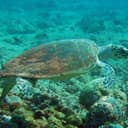
Showing details for the juvenile stage. Switch stages to see how it differs.
Overview
A young loggerhead starts out as a dark hatchling only about 4.6cm long, which races to the sea and swims far offshore to shelter in floating Sargassum weed until it has grown to about 45cm.
Hatchlings live among the floating mats in the open ocean, then move to coastal waters and shallow estuaries as they grow. Older juveniles keep to the continental shelf and to shallow estuaries, and in the northwestern Atlantic they use estuaries with limited access to the ocean more than non-nesting adults do. The Mediterranean works as a nursery, with almost half of its juveniles arriving from the Atlantic, and upwelling off Baja California feeds large numbers of young turtles and subadults.
Appearance
At hatching a turtle weighs about 20g and is light brown to almost black, with none of the yellows and reds of an adult. Males and females look the same until adulthood.
Behaviour
Once afloat a hatchling lets the undertow carry it the first few metres from shore, then swims for around 20 hours. A very young turtle also swims differently from an adult, holding its front flippers against the shell and kicking with the hind ones, and it moves over to the adult's alternating stroke by the age of one. Young loggerheads handle cold better than adults, not becoming stunned until the water falls below 9°C. On seasonal migrations juveniles steer by magnetic and visual cues together, and can manage with either one alone.
Feeding
The Sargassum works as cover and as a larder. It can hold as many as 100 animal species, and young turtles take barnacles, crab larvae, fish eggs and hydrozoans, along with ants, flies, aphids and beetles blown in on the wind. Adults, by contrast, feed mostly on invertebrates from the bottom.
Life cycle
Eggs are buried on the beach above the high-tide line and take about 80 days to incubate, and the warmth of the nest decides the sex, with about 30°C giving an equal mix. The central eggs of a clutch usually give the biggest, fastest-growing and most active hatchlings. The young dig their way out, usually at night, when darkness gives more cover and the surface sand is less hot, and head for the brighter horizon made by moon and starlight on the water. Many stay with the Sargassum, then move to nearshore water as juveniles. Maturity is still many years off, at 17 to 33 years.
Threats
Young turtles have far more enemies than adults. Ghost crabs, ants, beetles, snakes, gulls, foxes, raccoons, feral dogs and feral pigs all raid nests. Crabs, lizards, snakes and seabirds pick off hatchlings on the way down the beach, and crabs and fish such as parrotfishes and moray eels take them at sea. Introduced foxes once destroyed up to 95 percent of the clutches on one stretch of eastern Australia, and raccoons have taken nearly every clutch on some Florida beaches, though removing foxes and covering nests with wire mesh have helped.
Bright lights on developed coasts lure hatchlings inland, where they dry out or are eaten, and this kills tens of thousands a year. Cyclones flood nests and drown the embryos, and unusually warm sand can produce almost all females. At sea, juveniles gather in feeding areas that overlap with fishing, and many are caught by accident.
Notes & fun facts
- DID YOU KNOWThe temperature of the nest decides the sex: eggs kept at 32°C become females and those at 28°C become males.
- DID YOU KNOWA hatchling can lose up to 20 percent of its body mass just getting from the nest to the sea.
- DID YOU KNOWMagnetite in the brain lets young loggerheads sense the Earth's magnetic field and use it to navigate.
- DID YOU KNOWMost loggerheads living off the Pacific coast of the Americas hatched in Japan and rode the currents across the ocean.
How to identify
- Behaviour
- breathes airopen water
Tap any trait to see other fish that share it.
Habitat & where to find it
Where the juvenile stage lives, and where its photos were taken.
- Range · Indian Ocean, Pacific Ocean, Atlantic Ocean, Mediterranean
Found among floating mats of Sargassum weed in the open ocean as hatchlings, then in coastal waters and shallow estuaries as they grow.
Juvenile photos 0
Discussion
No comments yet. Seen one, or got a question about it? Start the discussion.
Deep dive
Taxonomy
- kingdomAnimalia
- phylumChordata
- orderTestudines
- familyCheloniidae
- genusCaretta
- speciesCaretta caretta (Linnaeus, 1758)
SourcesWoRMS
More in the family
Testudines
Eastern Long-Necked Turtle
Chelodina longicollis
4 photos
Flatback Turtle
Natator depressus
12 photos
Florida Softshell Turtle
Apalone ferox
2 photos
Green Turtle
Chelonia mydas
56 photos
Hawksbill Turtle
Eretmochelys imbricata
74 photos
Pond Slider
Trachemys scripta scripta
0 photos
Red-eared Slider
Trachemys scripta elegans
6 photos
Snaked-neck Turtle
Chelodina oblonga
2 photos