Loggerhead Turtle
Caretta caretta
Also known as: Atlantic Loggerhead Turtle, Caretta Atlantic Loggerhead Turtle, Loggerhead, Loggerhead Sea Turtle
- Atlantic Loggerhead Turtle
- Caretta Atlantic Loggerhead Turtle
- Loggerhead
- Loggerhead Sea Turtle
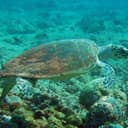
Showing details for the adult stage. Switch stages to see how it differs.
Overview
The loggerhead is the biggest hard-shelled turtle in the world, a heavy-headed sea turtle whose jaws crush whelks and conchs, and no other sea turtle has a longer list of known prey.
Foraging takes it through shallow estuaries, over coastal reefs and across open seas. Most of its life is split between the open ocean and shallow coastal water, and only females come ashore, for a short visit to nest. Divers most often meet it in shallow lagoons and on coral reefs, sometimes lying still beneath a rock with its eyes open.
Appearance
The huge head and heavy jaws are the giveaway. The head and shell run from yellow-orange to reddish brown, the underside is pale yellow, and the neck and sides are brown above and yellow lower down. A grown animal usually has a shell of 70 to 95cm and weighs 80 to 200kg. Only adults can be sexed by eye: males have much longer tails, longer claws, a wider head and a wider, flatter shell than females.
Behaviour
It is mostly active by day and may spend up to 85 percent of the day underwater, on dives that usually last 15 to 30 minutes.
Cold slows it right down. It turns sluggish at 13 to 15°C and floats, stunned, at around 10°C, so it moves to warmer water as the sea cools.
Females are unusually quarrelsome, and square up to each other over good feeding grounds. A dispute moves from wide circling to a face-off and snapping at each other's jaws, and throughout it a raised tail means carry on and a curled one means backing down.
Feeding
Bottom-living invertebrates make up most of its diet, and whelks, conchs, bivalves and horseshoe crabs are all crushed in those jaws. Sponges, corals, worms, sea urchins, fish, algae and even turtle hatchlings, its own included, have been recorded too. On migration it turns to jellyfish, floating molluscs and egg clusters, squid and flying fish. Pointed scales on the front flippers work like false claws: it rips large food apart on them, then twists its neck sideways to eat the pieces. Young turtles eat quite differently, picking small animals out of floating Sargassum weed.
Life cycle
Females first breed at anywhere from 17 to 33 years old, depending on the region, and the wild lifespan is estimated at 47 to 67 years. Unlike other sea turtles, loggerheads usually court and mate along migration routes rather than near the nesting beach.
Nesting runs from May to August in the Northern Hemisphere and from October to March in the Southern. A female returns to the beach where she hatched, or close to it, every 12 to 17 days through the season. She digs an egg chamber with her hind flippers, lays about 112 eggs on average and covers them, all within one to two hours. After about four clutches she lays no more for two or three years.
Dangers
Eating turtle meat or eggs can cause serious illness in people, through harmful bacteria and toxic metals that build up in the turtle's body.
Threats
Full-grown turtles have few enemies beyond large sharks, killer whales and monk seals, though up to 40 percent of nesting females carry wounds thought to come from sharks. Fishing gear is the biggest threat at sea, with turtles tangling in longlines and gillnets or trapped in trawls, pots and dredges, where they can drown. Floating plastic is easily mistaken for jellyfish and can block the gut or starve the turtle. Ashore, coastal building takes away nesting beaches. The IUCN lists the species as vulnerable.
Relationship with people
Loggerheads were once hunted heavily for their meat and eggs. Laws around the world have cut that back, but both are still eaten where the rules are loosely enforced, and in Mexico the eggs are a common meal, said locally to be an aphrodisiac.
Nesting beaches are now where people do the most to help. On Zakynthos, the biggest nesting site in the Mediterranean, Greek authorities ban planes from taking off or landing at night. Elsewhere, volunteers search the shore in season, rope off nests, move any at risk from spring tides or predators, and count what hatches. At sea, shrimp trawlers must carry turtle excluder devices, which give a trapped turtle a way out.
Notes & fun facts
- DID YOU KNOWGlands behind the eyes get rid of surplus salt, so a loggerhead on land can look as if it is crying.
- DID YOU KNOWA loggerhead can stay down for more than ten hours, longer than any other air-breathing marine vertebrate.
- DID YOU KNOWA tagged female called Adelita swam 14,500km from Mexico across the Pacific in 1996.
- DID YOU KNOWMore than 100 animal species and 37 kinds of algae have been found living on loggerheads' backs.
- DID YOU KNOWOne clutch of eggs can have as many as seven fathers, because females store sperm from several males.
How to identify
- Pattern
- blotches
- Behaviour
- breathes airopen water
Tap any trait to see other fish that share it.
Habitat & where to find it
Where the adult stage lives, and where its photos were taken.
- Range · Indian Ocean, Pacific Ocean, Atlantic Ocean, Mediterranean
- Country only · 3
Found foraging for food in shallow estuaries, coastal reefs, and over open seas.
Adult photos 3
Discussion
No comments yet. Seen one, or got a question about it? Start the discussion.
Deep dive
Taxonomy
- kingdomAnimalia
- phylumChordata
- orderTestudines
- familyCheloniidae
- genusCaretta
- speciesCaretta caretta (Linnaeus, 1758)
Morphology
AdultThe shell has a carapace of large plates, with five vertebral scutes along the midline, five pairs of costal scutes beside them and 11 or 12 pairs of marginal scutes around the rim. Three pairs of inframarginal scutes join it to the plastron. The head and flippers cannot be pulled into the shell. The skull is bulbous behind the eyes, which makes room for the big jaw muscles.
More in the family
Testudines
Eastern Long-Necked Turtle
Chelodina longicollis
4 photos
Flatback Turtle
Natator depressus
12 photos
Florida Softshell Turtle
Apalone ferox
2 photos
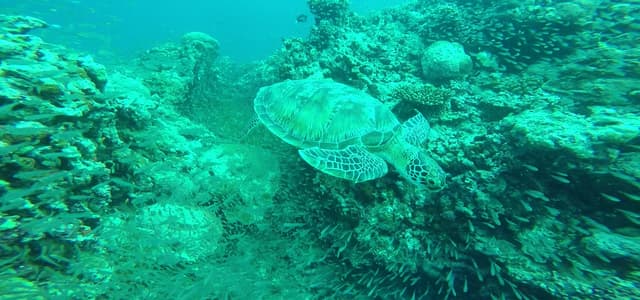
Green Turtle
Chelonia mydas
56 photos
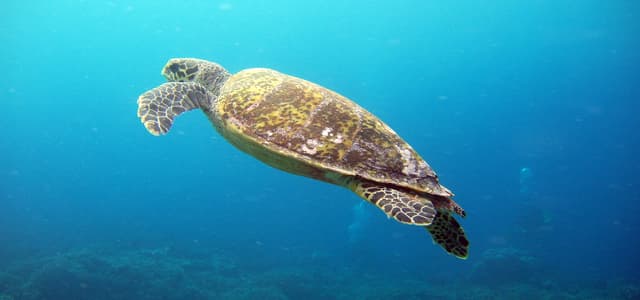
Hawksbill Turtle
Eretmochelys imbricata
74 photos
Pond Slider
Trachemys scripta scripta
0 photos
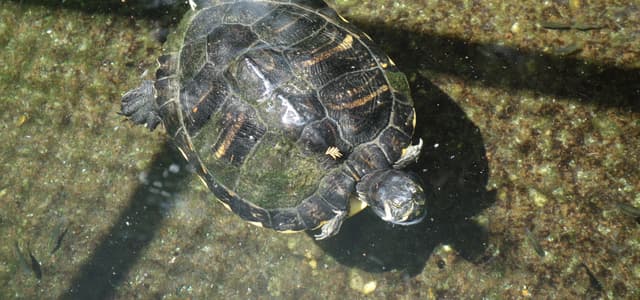
Red-eared Slider
Trachemys scripta elegans
6 photos
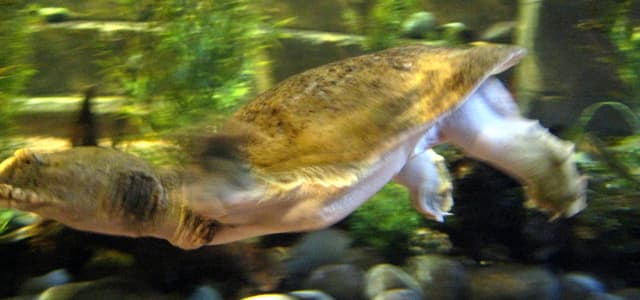
Snaked-neck Turtle
Chelodina oblonga
2 photos