Horn-eyed Ghost Crab
Ocypode brevicornis
Also known as: Ghost Crab, Horned Ghost Crab, Sand Crab, Shore Crab
- Ghost Crab
- Horned Ghost Crab
- Sand Crab
- Shore Crab
Overview
The horneyed ghost crab (Ocypode brevicornis) is a big, deep-bodied beach crab with short points on its swollen eyestalks, and its males defend their ground with drumming and elaborate sideways dances. It is one of six ghost crabs found around the Indian subcontinent.
It lives close to deep burrows on the open sandy and gravelly beaches of the Indian Ocean, near the intertidal zone, between the Gulf of Oman and the Nicobar Islands by way of India and Sri Lanka.
Appearance
Adults have a shell 24 to 41mm long and 26 to 50mm wide, rough with scattered bumps and shaped almost like a trapezoid, narrowing towards the rear. The feature to check is the swollen eyestalks, which carry short points at the tips in adults, though young crabs have much shorter points or none. Like other ghost crabs it has one claw far larger than the other.
Colour is a mottled mix of yellow and brown. Males tend to be the brighter, particularly on the legs. Juveniles match their background so closely that they are very hard to pick out.
Behaviour
These crabs are mostly active at night, although they do come out by day. They are extremely quick and wary, sprinting for the burrow at the first hint of trouble, even when the intruder is still some 9m away. After dark you can get a good deal closer, though a light may still send them running.
Males are showy and territorial. They rap the larger claw on the ground to make sound and vibration, as other ghost crabs do. When another ghost crab comes near a male may rear up, then shuffle sideways in ever more complicated moves, and finish by running in circles round the intruder until it gives up and leaves.
Feeding
Generalists on the beach, they scavenge carrion and debris and also catch small animals.
Notes & fun facts
- DID YOU KNOWThe inner palm of the larger claw has a sound-making ridge of 23 to 28 small bumps, and its pattern helps separate one ghost crab species from another.
- DID YOU KNOWThe points on the eyestalks only start to grow once a crab is around 12mm long.
- DID YOU KNOWIt is one of six ghost crab species found around the Indian subcontinent.
How to identify
- Pattern
- mottled
Tap any trait to see other fish that share it.
Diver’s cheat sheet
- 1BehaviourBy day they bolt for the burrow at the slightest alarm, even from 9m away, but they can be approached much more closely at night.
Habitat & where to find it
- Range · Indian Ocean
- Country only · 1
Found close to their deep burrows on the open sandy and gravelly beaches of the Indian Ocean.
Adult photos 1
Discussion
No comments yet. Seen one, or got a question about it? Start the discussion.
Deep dive
Taxonomy
- kingdomAnimalia
- phylumArthropoda
- classMalacostraca
- orderDecapoda
- familyOcypodidae
- genusOcypode
- speciesOcypode brevicornis H. Milne Edwards, 1837
Morphology
Shell wider than long, almost trapezoidal and narrower at the rear, with scattered rough bumps and squared-off eye sockets. Swollen eyestalks with the cornea filling most of the lower half and short points at the tips. One claw is much larger than the other, with a long, bumpy palm and a serrated lower edge, while the smaller claw tapers to a point. Mottled yellow to brown.
More in the family
Crabs (Ocypodidae)
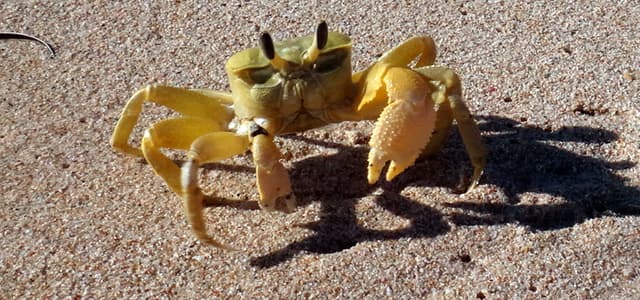
Golden Ghost Crab
Ocypode convexa
5 photos
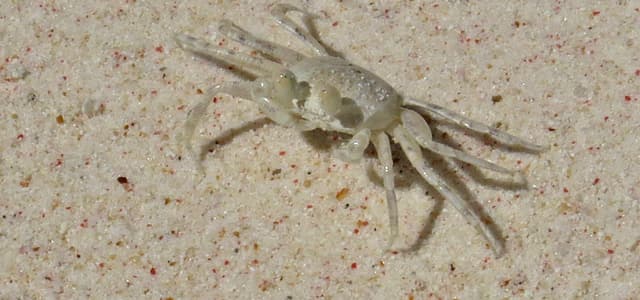
Horned Ghost Crab
Ocypode ceratophthalmus
3 photos
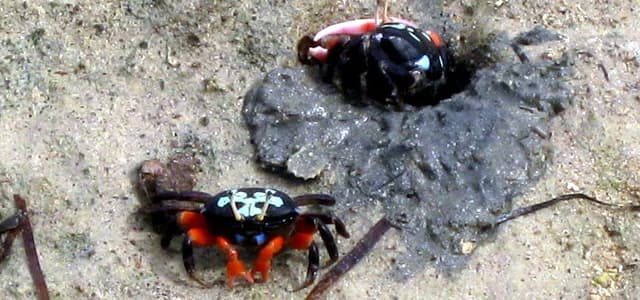
Mangrove Fiddler Crab
Paraleptuca crassipes
5 photos
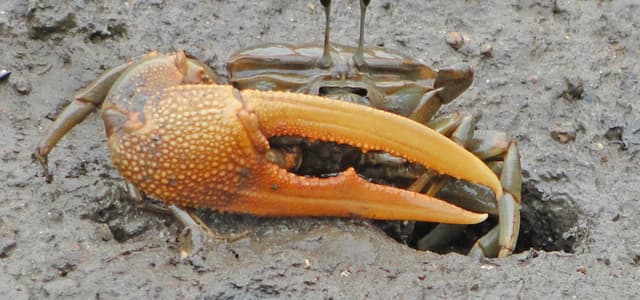
Orange Fiddler Crab
Gelasimus vocans
1 photo
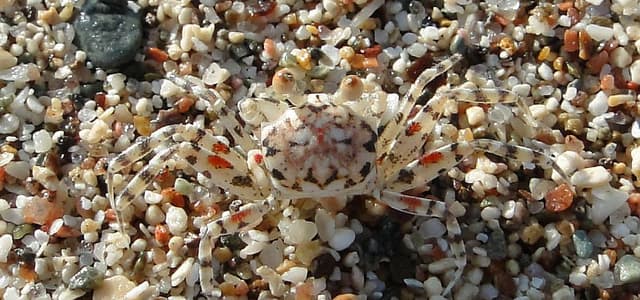
Pallid Ghost Crab
Ocypode pallidula
3 photos
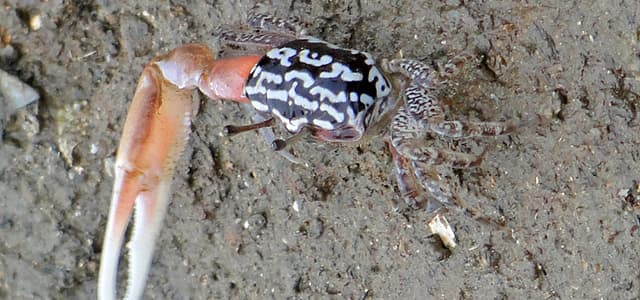
Porcelain Fiddler Crab
Austruca annulipes
5 photos
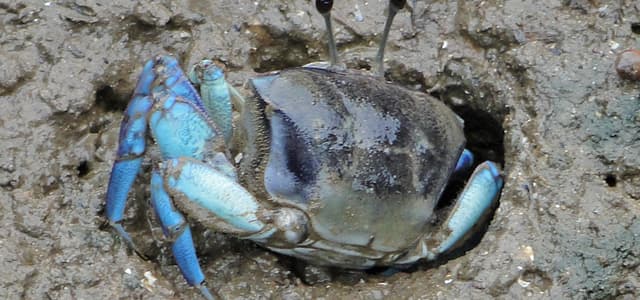
Tetragonal Fiddler Crab
Gelasimus tetrogonon
2 photos