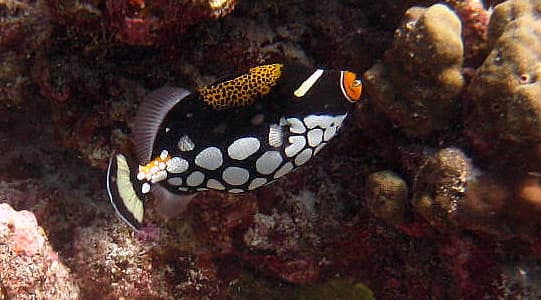
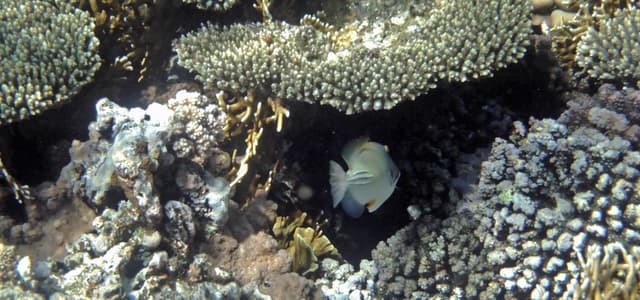
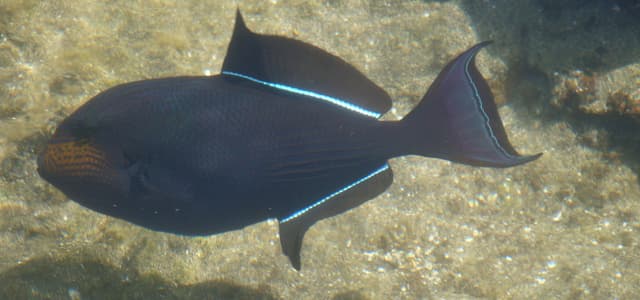
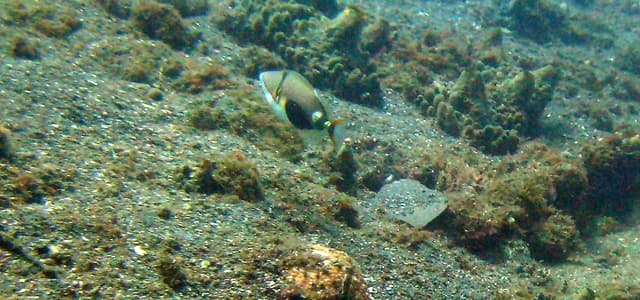
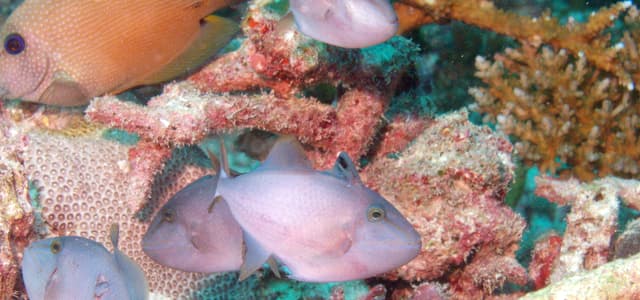
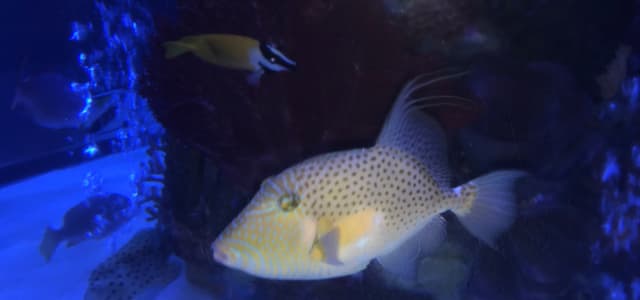
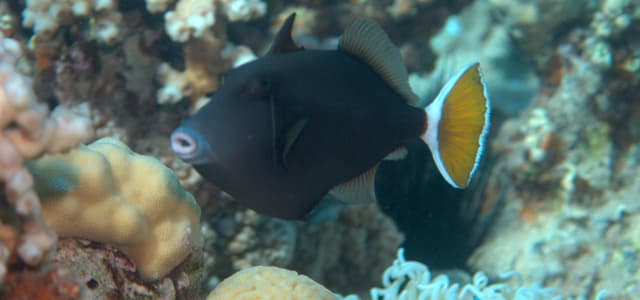
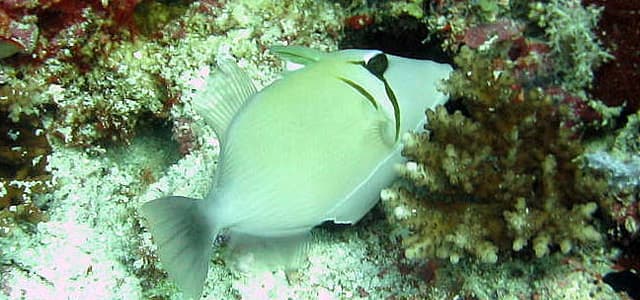
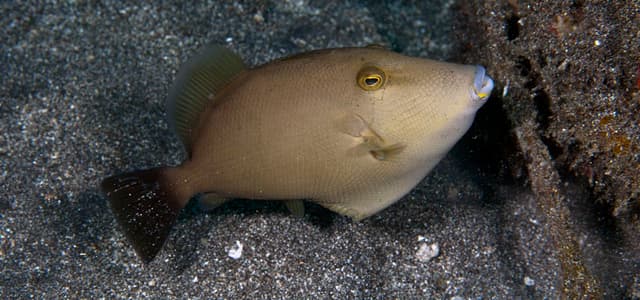
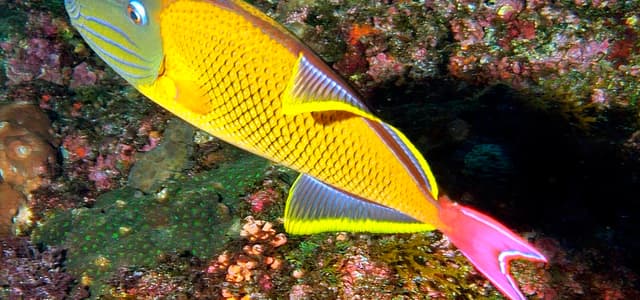
I hate these things. You know they are going to charge you when the spine on their head goes erect, that means it's reproductive season and so back off! It's like a fish that has PMT!! Beautiful colours though. Plentiful in the maldives.
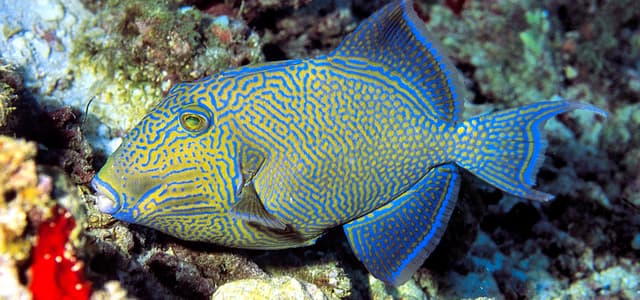
Titan Triggerfish
Balistoides viridescens
Also known as: Blue-and-Gold Triggerfish, Bluefin Triggerfish, Blue-finned Triggerfish, Dotty Triggerfish, Giant Triggerfish, Moustache Triggerfish, Titan Trigger
- Blue-and-Gold Triggerfish
- Bluefin Triggerfish
- Blue-finned Triggerfish
- Dotty Triggerfish
- Giant Triggerfish
- Moustache Triggerfish
- Titan Trigger
Overview
Found singly or in pairs, protecting their areas, over slopes of deep lagoons and seaward reefs.
Juveniles found close to isolated patches of branching corals, over protected, shallow sandy areas of reefs.
This is the largest and most aggressive of Triggerfish, in fact of any fish, especially when nesting when they will swim at speed and possibly take a chunk of flesh.
The Titan is distinctively coloured. The scales have dark centres. There is a black region with yellow spots covering the eyes and extending to the pectoral fin bases. The dorsal and anal fins have black margins. The fish is not a pelagic species and generally lives in the flat areas of the reef.
The Titan can be very aggressive towards divers and snorkellers. Especially during reproduction season it is very territorial and will guard its nest (which it lays in a flat sandy area) vigorously against any intruders. Due to its size and strong teeth it can inflict serious injury. Bites may also be ciguatoxic. The Titan Triggerfish will not always bite, but can charge with great speed at snorkellers and divers escorting them out of their territory. When the males (most colourful) start swimming in your direction, the best thing to do is swim away backwards kicking your fins as a defence. Failure to do so may result in being bitten.
A careful parent with a fierce temper, so take care.
These are the workers of the reef, often busy turning over rocks, stirring up the sand and biting off pieces of branching coral. This is why one often sees other smaller fish species around it who feed from the left overs.
Triggerfish have a hard spine dorsal fin that can be locked.
When sleeping this spine is used to wedge them into place in a crevasse and so deter predators from pulling them out of their bed!
The spine is also held erect as a warning to other fish to stay away.
Several large Titans blow shallow depressions in the sand for nesting and if approached will raise this spine as a warning, if ignored they may charge, even divers! especially the Titan Triggerfish who will take a tasty bite. Beware.
How to identify
- Pattern
- hatched lines
Tap any trait to see other fish that share it.
Habitat & where to find it
- Range · Indo-Pacific
- Exact location · 2
- Country only · 54
Found singly or in pairs, protecting their areas, over slopes of deep lagoons and seaward reefs.
Adult photos 57
Discussion 1
1 comment
- scubasteve· 3 Mar 2008
Deep dive
More in the family
Triggerfishes (Balistidae)

Blue Triggerfish
Pseudobalistes fuscus

Clown Triggerfish
Balistoides conspicillum

Assasi Triggerfish
Rhinecanthus assasi
2 photos

Black Triggerfish
Melichthys niger
16 photos

Blackpatch Triggerfish
Rhinecanthus verrucosus
6 photos

Blue-lined Triggerfish
Xanthichthys caeruleolineatus
1 photo

Bluespotted Triggerfish
Balistes punctatus
3 photos

Bluethroat Triggerfish
Sufflamen albicaudatum
3 photos

Boomerang Triggerfish
Sufflamen bursa
19 photos

Bridled Triggerfish
Sufflamen fraenatum
3 photos

Crosshatch Triggerfish
Xanthichthys mento
1 photo

Grey Triggerfish
Balistes capriscus