Bony fish
Painted Frogfish
Antennarius pictus
Also known as: Black Angler, Devil Fish, Painted Angler, Painted Anglerfish, Spotted Frogfish
ALSO KNOWN AS
- Black Angler
- Devil Fish
- Painted Angler
- Painted Anglerfish
- Spotted Frogfish
LCLeast ConcernIUCN Red List, 2022
HarmlessNot dangerous to divers
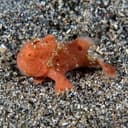
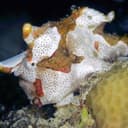
The Painted Frogfish is a squat, lumpy anglerfish that spends its life on the bottom, waiting motionless for prey to come within reach. It is best known as a master of camouflage by using its colour: individuals range from white, yellow and pink through orange, red and brown to black, usually with scattered dark spots and scab-like patches, and they slowly change colour to match the sponge or coral they sit on.
A banded rod on the snout, tipped with a tufted lure, draws in its food. It is widespread in the tropical Indo-Pacific, from the Red Sea and East Africa to Hawaii and French Polynesia, and from southern Japan south to Australia.
Showing details for the adult stage. Switch stages to see how it differs.
01
Overview
Adults are usually found sitting on or beside sponges, while juveniles tend to sit in the open on sand or reef. Many juveniles are black with scattered orange or yellow spots and blue-edged fins, whereas adults can be almost any colour.
Adults live on shallow, sheltered coral and rocky reefs, rubble, lagoons and sandy areas with a cover of sponges and algae. They have been recorded from the surface to 75m but are usually found shallower than 16m. They are regularly seen by divers in Indonesia (Lembeh Strait, Bali, Komodo, Flores), the Philippines, Borneo and the Maldives. In Australia they occur from the Houtman Abrolhos Islands in Western Australia around the north to Sydney, and at Lord Howe Island. Divers in New South Wales have photographed them in Botany Bay and Jervis Bay.
Appearance
The body is short, deep and globular, with no scales; the skin is covered in tiny forked spinules and many small, low warts. The largest recorded adults reach 30cm in total length, but most seen by divers are 10 - 20cm. Colour is extremely variable: whitish, cream, yellow, orange, pink, red, brown or black, usually with dark circular spots of various sizes and paler saddles on the shoulder and tail base. The tail fin nearly always carries three pale-edged spots. Dark individuals have white tips to the pectoral fin rays, and some are solid black with no markings.
The fishing rod (illicium) is darkly banded and nearly twice as long as the second dorsal spine. It ends in an elongate tuft of flattened appendages. The closest look-alike is the Warty Frogfish, Antennarius maculatus, which has large, obvious warts on its body and fins and a club-shaped second dorsal spine, where the Painted Frogfish’s warts are small and its second spine tapers. Young Painted Frogfish are also often confused with the Giant Frogfish, Antennarius commerson.
Behaviour
Adults lead a solitary life and are strongly territorial outside the breeding period. They remain still for hours or days in a chosen location, relying entirely on crypsis to avoid predators and deceive prey. When moving, they walk across the substrate using specialized, elbow-like pectoral fins. If startled, they can propel themselves through the water by expelling pressurized water from tiny, jet-like gill openings positioned behind their pectoral fins. A change of colour to match a new sponge or coral can take several days.
Feeding
They feed primarily on small reef fish, crustaceans, and shrimp. The hunting mechanism is one of the fastest strikes in the animal kingdom, taking as little as six milliseconds. The frogfish wiggles its lure above its mouth to mimic an injured prey; when a curious creature approaches, the frogfish expands its oral cavity to create a powerful vacuum, engulfing prey up to its own body size whole.
Life cycle
Breeding begins with courtship displays where the male follows the female as her belly swells with eggs. The pair ascends into the water column to release a buoyant, gel-like egg mass known as an egg raft, which floats with ocean currents. After hatching, the larvae drift among the oceans plankton for one to two months before settling onto shallow reefs to undergo metamorphosis into juveniles.
Dangers
Harmless to divers. They possess no venomous spines or aggressive tendencies toward humans.
Threats
The Painted Frogfish is listed as Least Concern on the IUCN Red List, assessed in September 2021, and is rated as having low vulnerability to fishing.
Relationship with people
Highly sought after by underwater photographers and muck divers due to their unique appearance and camouflage skills. They are occasionally collected for the private aquarium trade, where they require specialized live feeding and solitary housing.
Notes & fun facts
- DID YOU KNOWTheir ambush strike is among the fastest feeding movements of any vertebrate, engulfing prey in roughly six milliseconds.
- DID YOU KNOWPainted frogfish can swallow prey equal to their own body length thanks to an extraordinarily expandable stomach and mouth cavity.
- DID YOU KNOWThey walk along the seafloor using their modified pectoral and pelvic fins rather than swimming.
- DID YOU KNOWA Painted Frogfish can take several days to shift its colour to match a new sponge.
- DID YOU KNOWThe genus name Antennarius comes from the Latin word antenna, referring to a sensory organ and alluding to the modified dorsal-fin spine.
- DID YOU KNOWThe species was originally described under the name Lophius pictus in 1794, before being placed in its current genus.
02
How to identify
- Pattern
- blotchesocellated spotspots
Tap any trait to see other fish that share it.
Diver’s cheat sheet
- 1Look forRounded body, variable colour, dark-banded fishing rod and filamentous lure.
- 2BehaviourResting motionless on sponges or waddling slowly using their elbowed pectoral fins.
- 3Look forLook for white pectoral-fin tips and three spots on the tail.
03
Habitat & where to find it
Where the adult stage lives, and where its photos were taken.
- Range · Indo-Pacific
- Country only · 69
LIVES IN
Generally found singly (although occasionally in pairs or trios), perched motionless among sponges, coral outcrops, and jetties on sheltered reefs, usually between 1m and 75m depth.
RANGE
04
Adult photos 69
05
Discussion 2


ALL STAGES
FOR THE MARINE-BIOLOGY CURIOUS
Deep dive
Taxonomy
- kingdomAnimalia
- phylumChordata
- classTeleostei
- orderLophiiformes
- familyAntennariidae
- genusAntennarius
- speciesAntennarius pictus (Shaw, 1794)
Morphology
AdultGlobular and laterally compressed body covered in soft skin with small dermal spinules and scattered spots. Pectoral fins are limb-like and elbowed for walking along the substrate. The first dorsal spine is modified into a long fishing stalk (illicium) with a small, fleshy lure (esca) at the tip, while the mouth is large, upturned, and highly extensible.
06
More in the family
Frogfishes (Antennariidae)
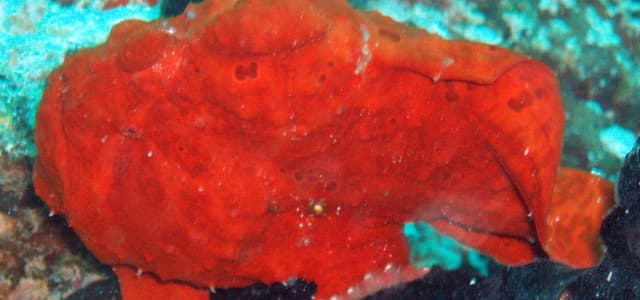
Commerson's Frogfish
Antennarius commerson
JuvenileAdult
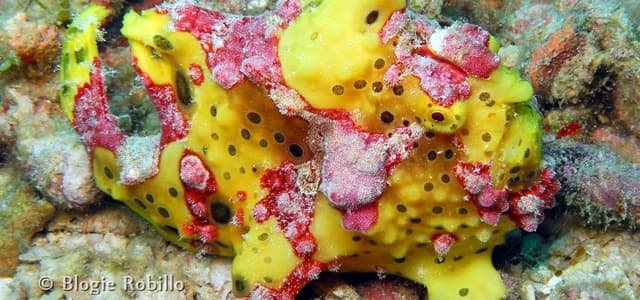
Warty Frogfish
Antennarius maculatus
JuvenileAdult
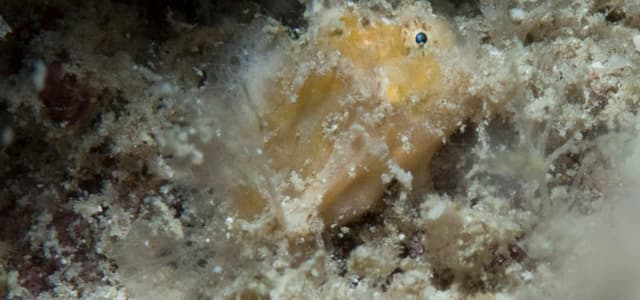
Hispid Frogfish
Antennarius hispidus
1 photo
Longlure Frogfish
Antennarius multiocellatus
2 photos
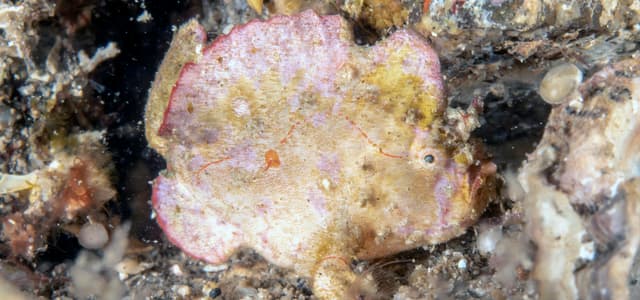
Randall's Frogfish
Antennarius randalli
2 photos
Sargassumfish
Histrio histrio
1 photo
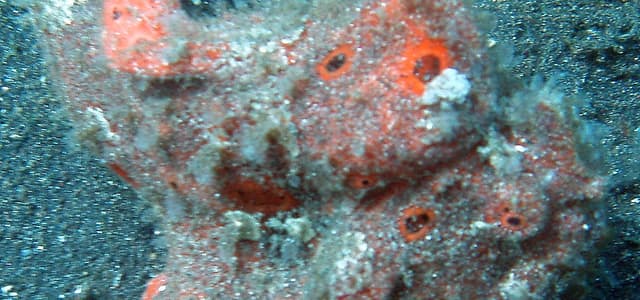
Scarlet Frogfish
Abantennarius coccineus
6 photos
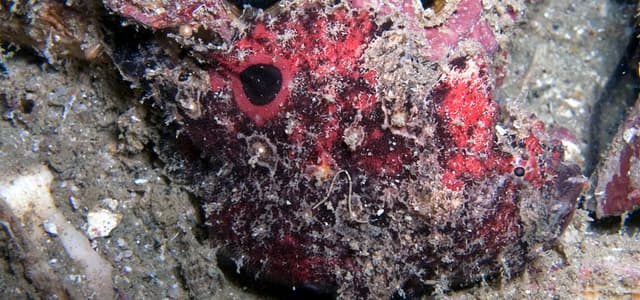
Spiny-tufted Frogfish
Abantennarius rosaceus
2 photos
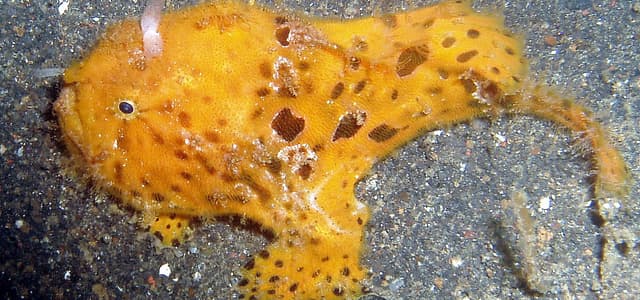
Spotfin Frogfish
Abantennarius nummifer
9 photos
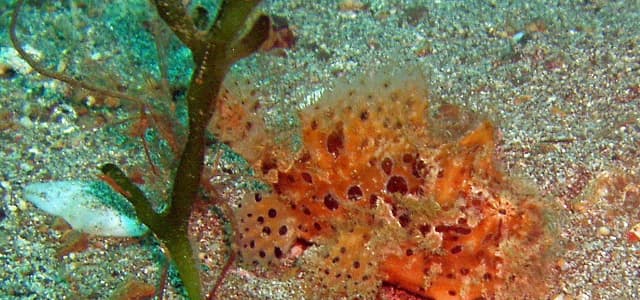
Striated Frogfish
Antennarius striatus
13 photos