Yellowstripe Scad
Selaroides leptolepis
Also known as: Gold-banded Scad, Horse Mackerel, Scad, Slender Trevally, Slender-scaled Trevally, Smooth-tail Trevally, Smooth-tailed Trevally, Thin-scaled Trevally, Trevally, Yellow-stripe Crevalle, Yellow-stripe Trevally
- Gold-banded Scad
- Horse Mackerel
- Scad
- Slender Trevally
- Slender-scaled Trevally
- Smooth-tail Trevally
- Smooth-tailed Trevally
- Thin-scaled Trevally
- Trevally
- Yellow-stripe Crevalle
- Yellow-stripe Trevally
Overview
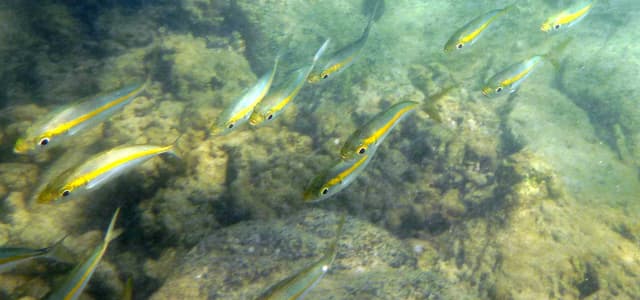
The yellowstripe scad is a small, silvery jack of the tropical Indo-West Pacific, easily picked out by the broad yellow band along its side, and in parts of its range it is among the most common fish there are.
It travels in large schools close to the bottom, over the soft seabed of inshore and shelf waters, and sometimes reaches freshwater tidal zones. Its range runs from the Persian Gulf and the Maldives across South East Asia to Japan, northern Australia, New Caledonia and Vanuatu. Australian fish keep to about 50m or shallower, while in Malaysia they have been recorded to 70m and are most common at 40 to 60m.
Appearance
The broad yellow band starts at the top edge of the eye and runs back to the base of the tail, with metallic blue to blue-green above it and silvery white below. A black spot stands out on the gill cover and often spreads onto the shoulder. The body is flattened from side to side, and the back and belly curve about equally. Most fish you see are well short of the 22cm maximum, usually under 15cm.
Behaviour
This is a schooling fish wherever it occurs, and it can be abundant in northern Australia, the Philippines and parts of India. Off Taiwan the schools move into coastal waters in summer and return to deeper shelf waters afterwards, but no other regular movements are known. Males and females are about equal in number at spawning time. Through the rest of the year females usually outnumber males, which may mean the sexes separate between spawning periods, although nobody is sure.
Feeding
Small prey makes up the diet, and it changes with place and season. In northern Australia the fish take mostly ostracods, sea snails and krill-like euphausiids. In India the menu is wider, led by crabs, shrimps and copepods, with smaller amounts of little fish, pteropods, algae, diatoms, mollusc larvae and foraminifera. Fish of different sizes eat somewhat different things, and the balance shifts through the year as each prey type becomes more or less plentiful. It feeds by day in India, yet feeding at night has been reported elsewhere.
Life cycle
Maturity comes early, at around 9 to 11cm, and one estimate puts it at less than a year old. The breeding season in India is long, with peaks from January to April and from July to October, although each fish spawns only once a year. Bigger fish carry far more eggs: about 6,300 were counted in a 9.5cm fish and up to 37,400 in one of 13.1cm. The eggs float freely in coastal and lower estuary waters. Larvae and juveniles shelter beside large jellyfish, as the young of other jacks do.
Threats
Larger predators hunt it, including big tuna and dolphins, and people catch it in great numbers for food and as bait. Fishing pressure looks low in some places, but stocks in part of India have been assessed as overexploited.
Relationship with people
This is an important catch for commercial and subsistence fishers alike. Trawls take most of it, with gill nets, bag nets, purse seines and push nets also used.
The flesh is dark and of fair eating quality. It is sold fresh or frozen, and in Asian countries it is often salted, cured or machine-dried into a fish snack. In Singapore and Malaysia, where it is called ikan kuning, it is commonly deep-fried until crisp and eaten with nasi lemak. Trials have also tried it as fish powder and surimi, and in Malaysia, where it is thought underused, in burgers mixed with threadfin bream, which went down well with buyers.
Notes & fun facts
- DID YOU KNOWYoung yellowstripe scad shelter with large jellyfish, and unusually they travel in front of the bell, moving forward in jerks that keep time with it.
- DID YOU KNOWIt is the only species in the genus Selaroides.
- DID YOU KNOWUnlike some of its relatives, it keeps on feeding while spawning, with no apparent change in what it eats.
- DID YOU KNOWIn Singapore and Malaysia it is known as ikan kuning and is often deep-fried until crispy to serve with nasi lemak.
How to identify
- Pattern
- yellow stripe
Tap any trait to see other fish that share it.
Diver’s cheat sheet
- 1Look forThe broad yellow band from eye to tail base, plus the black spot on the gill cover.
Habitat & where to find it
- Range · Indo-West Pacific
- Country only · 1
Found in large schools, over soft bottoms of inshore and shelf waters, sometimes reaching freshwater tidal zones.
Adult photos 1
Discussion
No comments yet. Seen one, or got a question about it? Start the discussion.
Deep dive
Taxonomy
- kingdomAnimalia
- phylumChordata
- classTeleostei
- orderCarangiformes
- familyCarangidae
- genusSelaroides
- speciesSelaroides leptolepis (Cuvier, 1833)
Morphology
A compressed, elongate, oblong body with back and belly equally curved. The upper jaw has no teeth and the lower has a single row of fine ones, a key feature of the species. Compared with the scads of the genus Selar it has a smaller eye and different teeth. The dorsal fin is in two parts and the pectoral fin is sickle-shaped. The dorsal, anal and tail fins are pale to dusky yellow, the pelvic fins white and the pectoral fins clear.
More in the family
Pompanos (Carangidae)
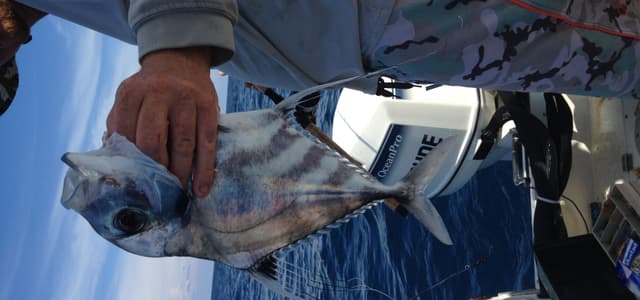
African Pompano
Alectis ciliaris
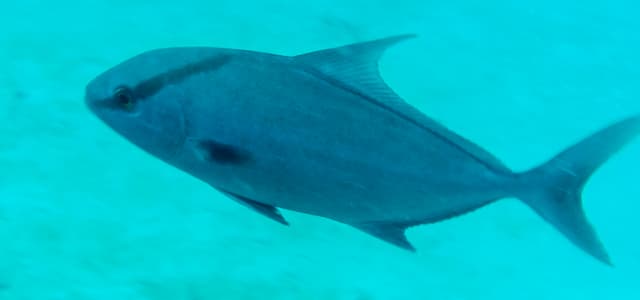
Almaco Jack
Seriola rivoliana
7 photos
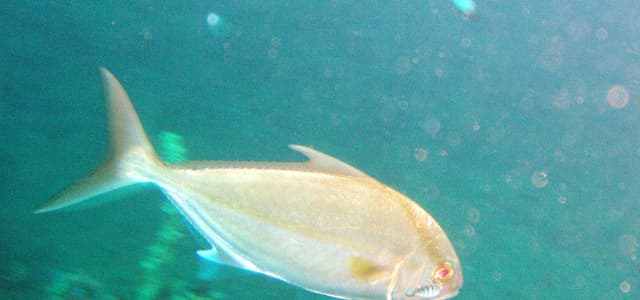
Amberjack
Seriola dumerili
3 photos
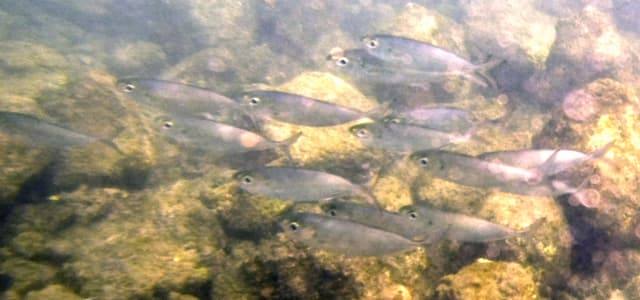
Amberstripe Scad
Decapterus muroadsi
1 photo
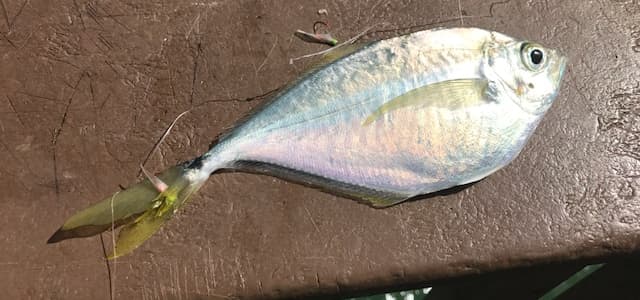
Atlantic Bumper
Chloroscombrus chrysurus
1 photo
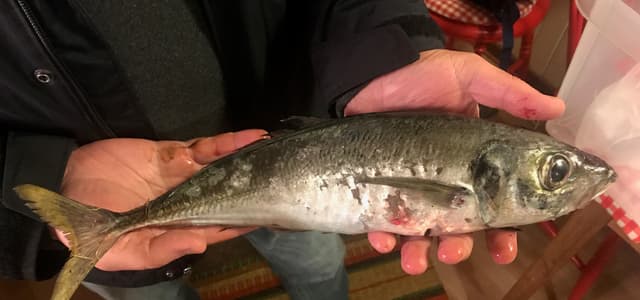
Atlantic Horse Mackerel
Trachurus trachurus
1 photo

Banded Rudderfish
Seriola zonata
2 photos
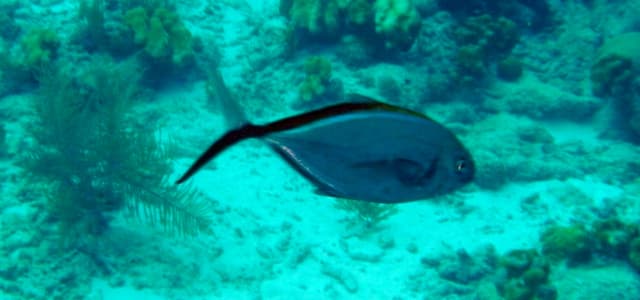
Bar Jack
Caranx ruber
14 photos
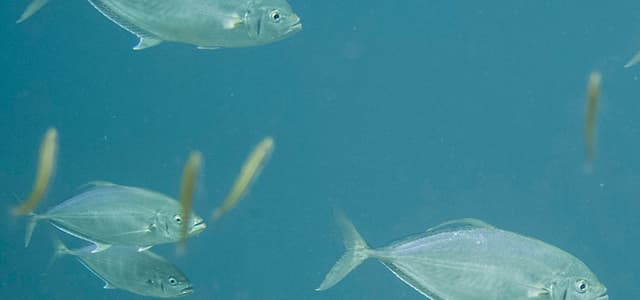
Barcheek Trevally
Craterognathus plagiotaenia
1 photo
Bigeye Scad
Selar crumenophthalmus
4 photos
Bigeye Trevally
Caranx sexfasciatus
27 photos
Black Jack
Caranx lugubris
7 photos