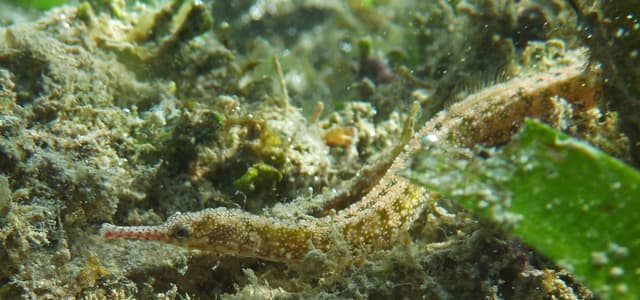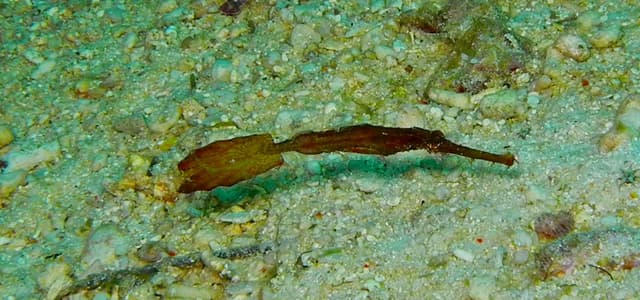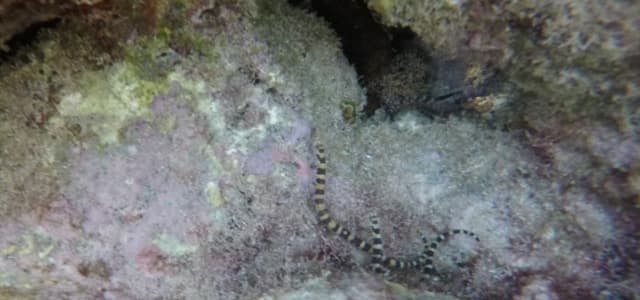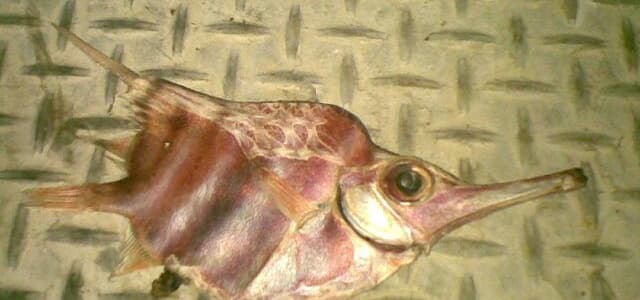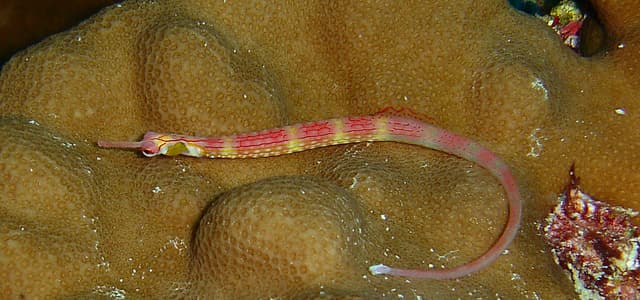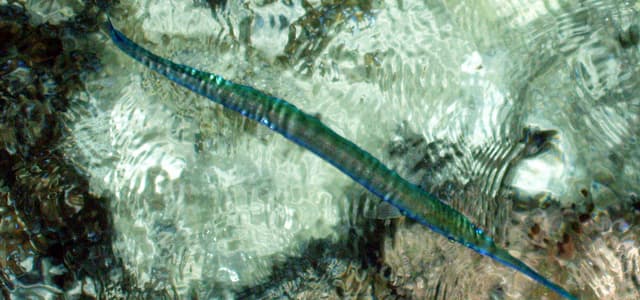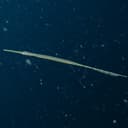
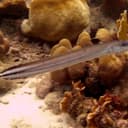
Ha! Great information! We are snorkeling in West Maui and fascinated by these flute-like or clarinet-like fish. Not getting the trumpet, but what do I know? I was so curious why some are deep ochre or bright yellow, others nearly transparent beige/sand color, and others olive with white stripes and dots. I can't wait to get back out there and watch them feed. I have not noticed them stalking, just swimming aimlessly about.
Trumpetfish
Aulostomus maculatus
Also known as: Atlantic Trumpetfish, Caribbean Trumpetfish, Painted Flutemouth, Trumpet, Trumpeter
- Atlantic Trumpetfish
- Caribbean Trumpetfish
- Painted Flutemouth
- Trumpet
- Trumpeter
Showing details for the adult stage. Switch stages to see how it differs.
Overview
Found singly, either snout down, mimicking whip corals, or swimming alongside herbivore fish, changing colour, to match the fish and their surroundings, ready to pounce on any other unsuspecting crustacean or fish. Varies in colour to match surroundings or fish they are stalking!
They feed by opening their mouths to the size of their bodies, and sucking in their prey of crustaceans and small schooling reef fishes.
The Trumpetfish can be recognised by its long body, tubular snout with minute teeth, its chin barbel and the series of short dorsal spines.Their bodies are inflexible, supported by interwoven struts of bone. The colouration of this species is variable. It is often brown or green with pale stripes and bars, and white spots posteriorly. A yellow colour variety is common in some areas. Individual fish have the ability to change their colours very quickly. Trumpetfish have the capability to rapidly expand their jaws into a circular gaping hole almost the diameter of their body when feeding. They are carnivores, hovering almost motionless just a few inches above the substrate, slowly inching their way towards unsuspecting prey. When they get close enough, they rapidly dart in, expanding their jaws. The rapid opening of their tube-like mouths creates a strong sucking force, drawing their prey straight into their oral cavities.
Although Trumpetfish can be found in various colours, because of their ability to change colour at will, there is in fact only one genus with two species, one Pacific and one Atlantic.
How to identify
Tap any trait to see other fish that share it.
Habitat & where to find it
Where the adult stage lives, and where its photos were taken.
- Range · Western Atlantic, Caribbean
- Country only · 22
Found singly, either snout down, mimicking whip corals, or swimming alongside herbivore fish, changing colour, to match the fish and their surroundings, ready to pounce on any other unsuspecting crustacean or fish.
Adult photos 22
Discussion 3
3 comments
- allison· 2 Jun 2017
- Bill Beck· 3 Nov 2016
I recently went on a trip Yellow Submarine off Tenerife. I video da&page fish which I think was a trumpet fish. Could this be possible as Far East of Carribean
Deep dive
More in the family
Syngnathiformes

Alligator Pipefish
Syngnathoides biaculeatus
1 photo

Armored Pipefish
Solenostomus armatus
1 photo

Banded Pipefish
Micrognathus crinitus
4 photos

Banded Yellowfish
Centriscops humerosus
1 photo

Bastard Seahorse
Acentronura gracilissima
1 photo

Belly-barred Pipefish
Hippichthys spicifer
1 photo

Benedetto's Pipefish
Corythoichthys benedetto
1 photo

Bigbelly Seahorse
Hippocampus abdominalis
3 photos

Black-breasted Pipefish
Corythoichthys nigripectus
1 photo

Blue-spotted Cornetfish
Fistularia commersonii
65 photos

Bluestripe Pipefish
Doryrhamphus excisus
1 photo

Brown-banded Pipefish
Corythoichthys amplexus
1 photo