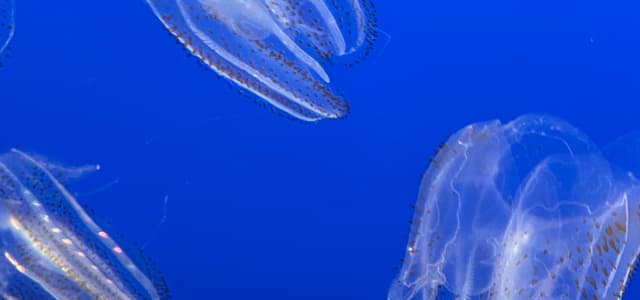
I was with a group of about 10 divers who encountered large groups of these jellyfish near the surface (from 0 to 5 meters deep roughly) today. Some of us seemed to have more reaction to the stings than others but these jellies definitely have a mild sting. It did seem like sensitive skin surfaces like the neck were far more likely to be stung than tougher skin like the hairy outside of my forearm.
Spotwing Comb Jelly
Ocyropsis maculata
Also known as: Ctenophore, Lobate Comb Jelly, Sea Gooseberry, Sea Jelly, Sea Walnut, Spot-winged Comb Jelly
- Ctenophore
- Lobate Comb Jelly
- Sea Gooseberry
- Sea Jelly
- Sea Walnut
- Spot-winged Comb Jelly
Overview
Found over inshore waters and shelf and slopes, of the continental shelf.
Almost all ctenophores function as predators, taking prey ranging from microscopic larvae and rotifers to the adults of small crustaceans; the exceptions are juveniles of two species, which live as parasites on the salps on which adults of their species feed.
How to identify
Habitat & where to find it
- Range · Western Central Atlantic, Caribbean
- Country only · 9
Found over inshore waters and shelf and slopes, of the continental shelf.
Adult photos 9
Discussion 4
4 comments
- Kevin· 8 May 2022
- Gary· 4 Jun 2021
Our group of 15 skin divers encountered small "herds" of Spotwing Comb jellies and we can confirm that against all reporting, these jellies do in-fact sting. While the initial sting is little more than a pinch, the marks developed into itchy bumps similar (some worse, some milder) to a mosquito bite over the next 48 hours.
- Sean· 1 Jan 2025
Encountered a small group just off the coast of Cozumel. Almost impossible to distinguish from seawater until about 3-5 ft away. The sting was similar to a small pinprick, and the stung areas are beginning to itch.
- Dd· 24 Mar 2023
These lovely creatures do NOT sting unless you stick your fingers in them - leave them alone and they're perfectly nice companions for a swim! They are all around the beaches of Curacao in March and people who live here never have a problem with them!
Deep dive
More in the family
Lobata