
xs6615· 15 Mar 2013
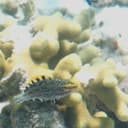
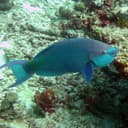
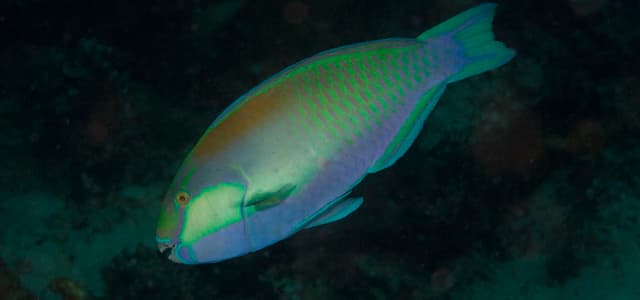
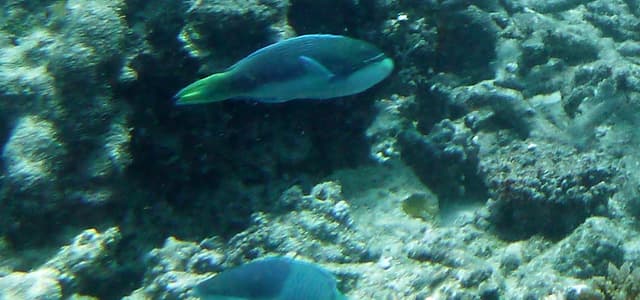
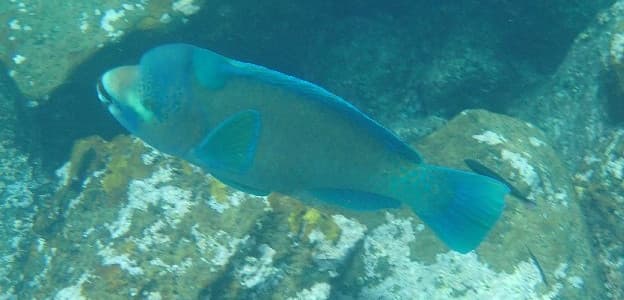
It strongly seems that the first picture is not the same as the other pictures as the caudal (tail) fin is completely different. I am trying to identify the first photograph, but it does not seem to be the Greenthroat.
Scarus prasiognathos
Also known as: Blue-faced Parrotfish, Dusky Parrotfish, Greencheek Parrotfish, Greenface Parrotfish, Greenthroat Parrotfish, Ocean Parrotfish
Showing details for the adult stage. Switch stages to see how it differs.
Found in large schools, foraging for food over shallow, protected reef flats, and seaward reef slopes, although more often over outer reefs rich in algae growth.
Parrotfish are hermaphrodites and live in harems with a dominant male. They are not territorial, living and feeding in harmony with other species.
Their teeth are fused into powerful beaks which are used for grabbing filamentous algae from dead coral, often found feeding in a cloud of sediment.
At night parrotfish make a sleeping bag out of slime bubbles for protection against predators.
These beautiful fish whose males usually outshine the females for colour also change dramatically from juvenile to adult.
- Build-in beak: The parrot-like 'beak' isn't just for show. It's made of fused teeth strong enough to scrape algae off of rock and coral. If you listen whilst snorkelling or diving, you can often hear the crunching sounds
- Gender swap: These Singapore Parrotfish start their life as females. Later on in life, some transform into males, complete with new colors and social roles.
- Night bags: At night, parrotfish secrete a slimy mucus cocoon around themselves. It acts like a sleeping bag, hiding their scent from predators such as moray eels.
- Sand makers: By grinding up algae and bits of coral, they literally poop out fine white sand. A single parrotfish can produce hundreds of kilograms of sand per year.
- Social butterflies: they're often seen in big schools, sometimes mixed with other parrotfish species, making the reef look like an underwater parade of color.
Where the adult stage lives, and where its photos were taken.
Found in large schools, foraging for food over shallow, protected reef flats, and seaward reef slopes, although more often over outer reefs rich in algae growth.
2 comments
It strongly seems that the first picture is not the same as the other pictures as the caudal (tail) fin is completely different. I am trying to identify the first photograph, but it does not seem to be the Greenthroat.
Parrotfishes (Scaridae)
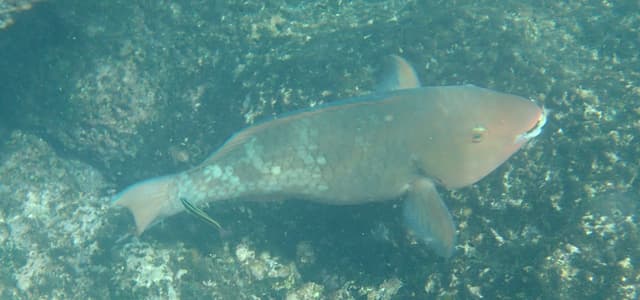
Scarus compressus
1 photo
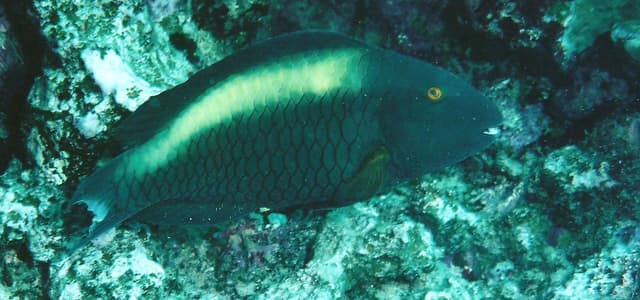
Cetoscarus bicolor
Chlorurus bleekeri
8 photos
Scarus coeruleus
Scarus ghobban
61 photos
Cryptotomus roseus
Chlorurus atrilunula
0 photos
Scarus forsteni
Chlorurus bowersi
1 photo
Scarus frenatus
Sparisoma radians
Scarus perrico
1 photo
