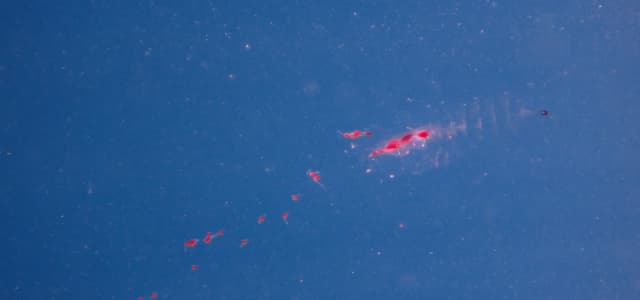
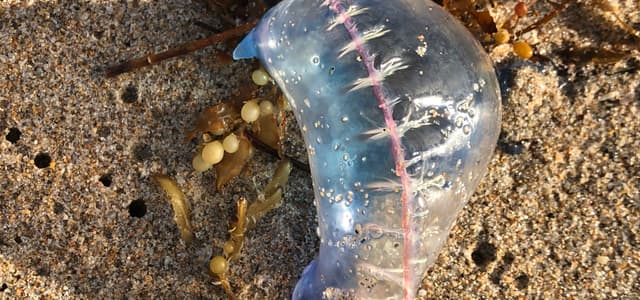
Red-spotted Siphonophore
Forskalia edwardsi
Also known as: Medusa Jelly, Sea Jelly, Siphonophore, Zooids
- Medusa Jelly
- Sea Jelly
- Siphonophore
- Zooids
Overview
Found floating in open waters with tentacles extended to ensnare prey.
Length - 2cm each - many joined together
These jellyfish are made up of tiny swimming bells ranging from 1 to many, propelled by a gas float they float in the water with their many tentacles extented to catch their prey.
They are not dangerous will produce an intense sting and redness but not death!
Jellyfish are 95% water.
They have no heart, brain, blood, or gills. The body of the Jellyfish is called a bell. They do have a mouth, tentacles and arms around their mouth. They use their arms around their mouth to help sense and find food that ends up inside their mouth.
In the winter they disintegrate, the offspring surviving as larvae attached to the bottom. By asexual reproduction they form stacks of platters, and these platters are released in the spring to start their pelagic life.
Their only predators are Bannerfish and Arrow Crabs.
How to identify
Habitat & where to find it
- Range · Pacific Ocean, Atlantic Ocean
- Country only · 1
Found floating in open waters with tentacles extended to ensnare prey.
Adult photos 1
Discussion
No comments yet. Seen one, or got a question about it? Start the discussion.
Deep dive
Taxonomy
- kingdomAnimalia
- phylumCnidaria
- classHydrozoa
- orderSiphonophorae
- familyForskaliidae
- genusForskalia
- speciesForskalia edwardsi Kölliker, 1853
SourcesWoRMSSeaLifeBase
More in the family
Siphonophorae