Oriental Maori Wrasse
Oxycheilinus orientalis
Also known as: Maori Wrasse, Oriental Wrasse, Slender Maori Wrasse, Slender Wrasse, Thicklip Wrasse, Thickstripe Maori Wrasse
- Maori Wrasse
- Oriental Wrasse
- Slender Maori Wrasse
- Slender Wrasse
- Thicklip Wrasse
- Thickstripe Maori Wrasse
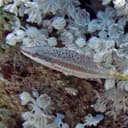
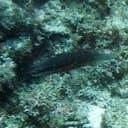
Showing details for the adult stage. Switch stages to see how it differs.
Overview
The Oriental Maori Wrasse (Oxycheilinus orientalis) is a small, slender reef fish whose orange-red colour can shift quickly, a cryptic relative of the giant Humphead Maori Wrasse (Cheilinus undulatus) that often hides in the arms of mushroom coral. Despite the shared name it reaches only 15 to 20cm.
It lives singly or in small groups over sandy, rubble and algae-rich areas of sheltered bays, lagoons and outer reef slopes, often among the arms of the mushroom coral Heliofungia actiniformis. It ranges through the tropical Indo-West Pacific, from the Red Sea to northern Australia and the Great Barrier Reef, north to southern Japan and east to the Marshall Islands. At 10 to 80m it keeps to fairly deep water, so divers are more likely to meet it on the deeper parts of a slope.
Appearance
The body is orange-red to reddish pink. A dark reddish stripe runs along the middle of the body from the snout through the eye to the base of the tail, with a pale white stripe either side. Two small black and red spots sit towards the rear, and the white pelvic and anal fins have bright red markings. Females also have about five pale saddle-like bars over the back that reach down the sides.
Behaviour
Males tend to be solitary and territorial, while females often swim in small groups. Wrasses in general are busy all day but first to bed and last to rise, with small ones sleeping under the sand and larger ones wedged into crevices.
Feeding
It is an opportunistic predator of small fish, shrimps and other crustaceans living near the bottom. Wrasses as a group have small protruding teeth for taking food from the bottom, and grind down hard shells with a second set of jaws in the throat.
Life cycle
Like other wrasses it changes dramatically in colour and shape from juvenile to adult. Young fish are highly cryptic, sheltering among soft corals or feather stars. Adults begin mature life as females, and some can later become males.
Notes & fun facts
- DID YOU KNOWParts of its body fluoresce yellow under blue light.
- DID YOU KNOWIt starts mature life as a female and can later change into a male.
How to identify
- Pattern
- stripes
- Behaviour
- changes coloursolitaryterritorial
Tap any trait to see other fish that share it.
Habitat & where to find it
Where the adult stage lives, and where its photos were taken.
- Range · Indo-West Pacific
- Exact location · 1
- Country only · 1
Found singly or in small groups over sandy, rubble and algae-rich areas of sheltered bays, lagoons and outer reef slopes, often in the arms of the mushroom coral Heliofungia actiniformis.
Adult photos 2
Discussion
No comments yet. Seen one, or got a question about it? Start the discussion.
Deep dive
Taxonomy
- kingdomAnimalia
- phylumChordata
- classTeleostei
- orderEupercaria incertae sedis
- familyLabridae
- genusOxycheilinus
- speciesOxycheilinus orientalis (Günther, 1862)
Morphology
AdultA slender wrasse with a dark reddish midlateral stripe bordered by pale stripes, running from the snout through the eye to the tail base. Two small black and red spots sit on the rear of the body, and the pelvic and anal fins are white with bright red markings. Females add about five pale saddle-like bars.
More in the family
Wrasses (Labridae)
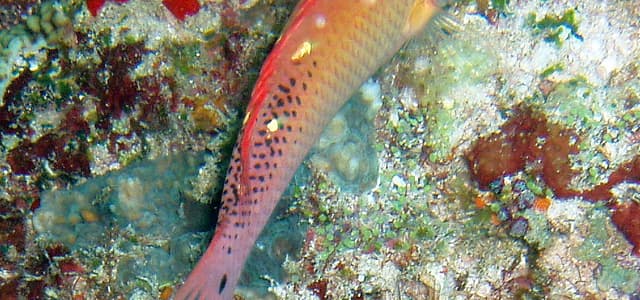
Diana's Hogfish
Bodianus diana
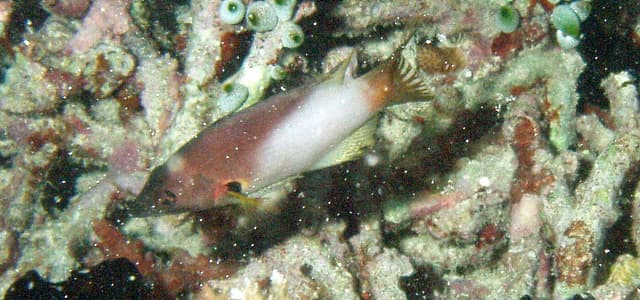
Axilspot Hogfish
Bodianus axillaris
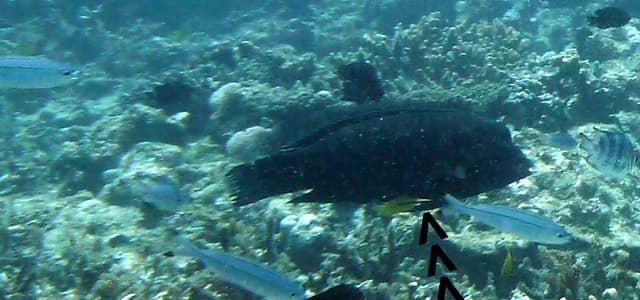
Doubleheader
Coris bulbifrons
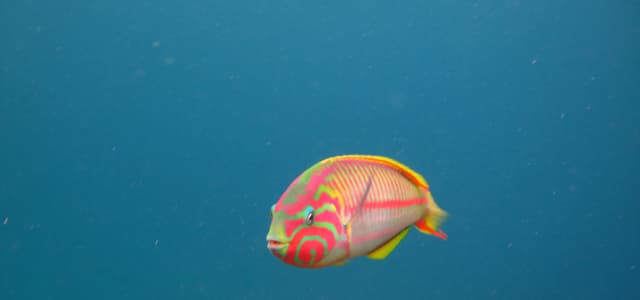
Klunzinger's Wrasse
Thalassoma rueppellii
Knife Razorfish
Cymolutes praetextatus
Peacock Wrasse
Iniistius pavo
Rockmover Wrasse
Novaculichthys taeniourus
Abudjube Wrasse
Cheilinus abudjubbe
2 photos
Adorned Wrasse
Halichoeres cosmetus
African Clown Coris
Allocoris cuvieri
African Coris
Coris gaimard
Anchor Tuskfish
Choerodon anchorago
6 photos