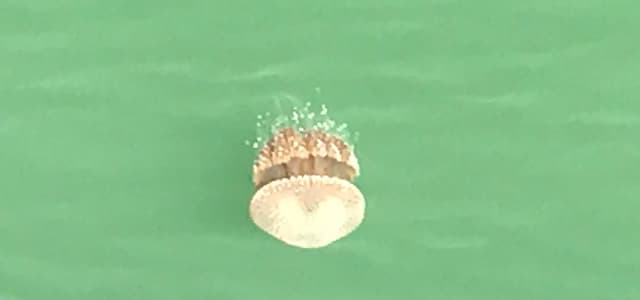
Upside-down Jellyfish
Cassiopea andromeda
Also known as: Upside-down Sea Jelly, Sea Jelly, True Jellyfish
- Upside-down Sea Jelly
- Sea Jelly
- True Jellyfish
Overview
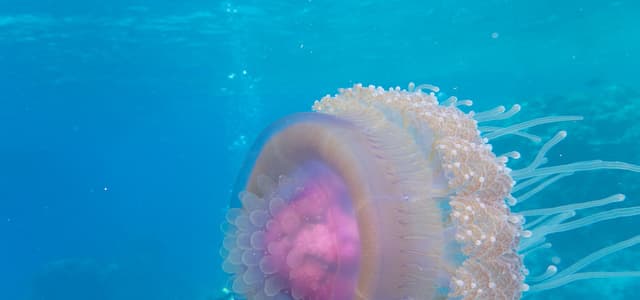
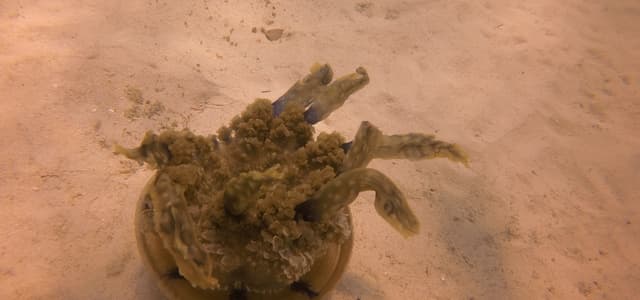
Found in shallow waters, over mudflats, sandy bottoms and seagrass beds of shallow lagoons and mangroves. Often in the sun, they lie on their backs and so look more like anemones or sea stars. These jellyfish rest upside down, to get more light to their tentacles which collect algae which in turn provides food for the jellyfish through photosynthesis.
They feed on zooplankton.
Diameter 30cm
Sometimes these Jellyfish are picked up by decorator crabs and ride on their backs as defense against predators.
Although their sting is very mild!
Named after one of Greek mythology's treacherous queens Cassiopeia!
Cassiopeia is also a constellation in the sky.
Jellyfish are 95% water.
They have no heart, brain, blood, or gills. The body of the Jellyfish is called a bell. They do have a mouth, tentacles and arms around their mouth. They use their arms around their mouth to help sense and find food that ends up inside their mouth.
Their predators are Sea Turtles and Sunfish.
How to identify
- Body shape
- fingers
- Behaviour
- bottom dwellingupside down
Tap any trait to see other fish that share it.
Habitat & where to find it
- Range · Indo-Pacific
- Country only · 10
Found in shallow waters, over mudflats, sandy bottoms and seagrass beds of shallow lagoons and mangroves.
Adult photos 10
Discussion
No comments yet. Seen one, or got a question about it? Start the discussion.
Deep dive
More in the family
Rhizostomeae