@fishx6 · Lembeth Resort, Indonesia · June 20061 / 14
01
Overview
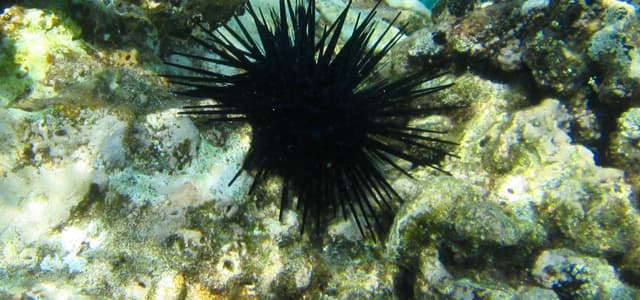
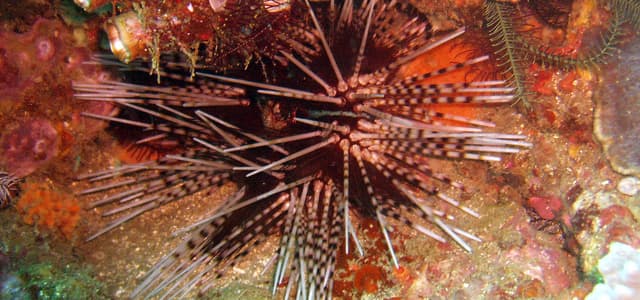
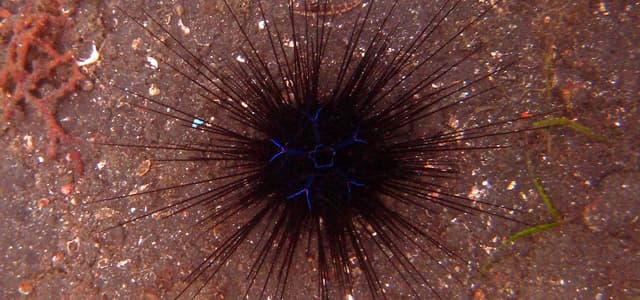
The red urchin is a large tropical sea urchin with long spines set in five clusters and bare red patches lined with iridescent blue dots, a colourful favourite of underwater photographers.
It is found singly, or gathered in dense groups, moving across sand, shingle and coral rubble in bays and lagoons, usually at 10 to 30m and down to about 70m. Its range stretches across the Indo-Pacific from Africa to Hawaii and Australia. The Caribbean urchin Astropyga magnifica is a separate species.
Appearance
The top of the shell is flat or slightly dished. Between the spine clusters lie bare V-shaped areas, red with their blue dots, and these are the best feature to look for. The rest of the animal can be reddish brown, purple, dark brown or almost black, and orange, black-and-orange and rare white individuals have also been seen. Juveniles have banded spines, and some keep the banding as adults.
Behaviour
It is mostly active at night. It is sensitive to light and can angle its spines towards anything threatening that comes near.
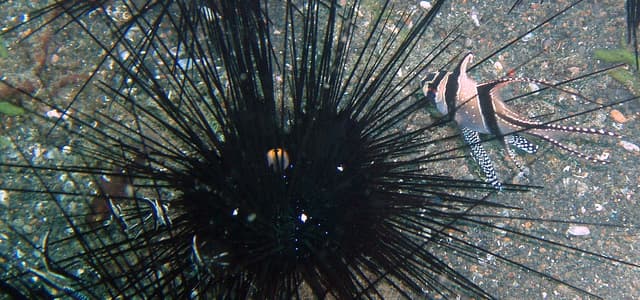
The spines give shelter to a small community of other animals. The shrimps Periclimenes hirsutus and Stegopontonia commensalis live on it, as does the crab Zebrida adamsii, and young fish hide among the spines, including emperor red snappers, cardinalfish and zebra lionfish.
Feeding
It grazes on algae, using five powerful teeth set in the middle of its underside.
Life cycle
Males and females are separate animals, and both release their eggs or sperm into open water. The fertilised eggs become drifting larvae, which go through a series of stages, then settle on the bottom and change into tiny juvenile urchins.
Dangers
The shorter of its two kinds of spine are venomous. A wound is painful but not deadly, and the urchin's size and colour mean accidental injuries are fairly rare, since divers can usually see it before touching it or stepping on it.
Threats
Triggerfish and large wrasses prey on sea urchins, nibbling away the spines before turning them over to reach the soft underside.
Notes & fun facts
DID YOU KNOWThe crab Dorippe frascone carries this urchin around on its back.
DID YOU KNOWSome live in water so shallow that a falling tide can leave them exposed, at the risk of drying out and dying.
DID YOU KNOWThe five teeth around the mouth form a structure known as Aristotle's lantern.
DID YOU KNOWThe sting rates 12 out of 30 on the Kings of Pain index.
Hello -- we recently found a radiant sea urchin in the Sea of Cortez near Guaymas. We have never seen one of these in the Sea of Cortez and in reading about them understand that they are Indo-Pacific. How in the world did this sea urchin get here?
hi saw one of these today in the virgin islands. They are magnificent, but are they invasive here? this is the first site I have seen that lists them in the Caribbean all others list them as indo-pacific. How venomous are they?thanks so much!
The Caribbean urchin is known as Astropyga magnifica, like ther Indo-pacific counterpart they can be found in large aggregations.
In 1983-1984 there was an epidemic of the Long-spined Sea Urchin - Diadema antillarum, not sure about this one!
The spines can give a very painful wound and often need antibiotics, and thorough removal of any broken spines. My own experience is that they don't dissolve as some books suggest but cause a nasty abscess, especially if other bugs or matter are on the spikes.
The shell, or test, reaches 20cm across and is flat or slightly dished on top. Hollow spines are arranged in five vertical clusters, with bare V-shaped zones between them. There are two kinds of spine, and the shorter kind is venomous. A prominent brown anal sac with a dark tip sits on top.