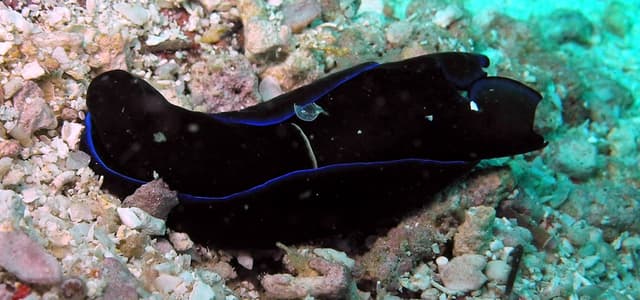
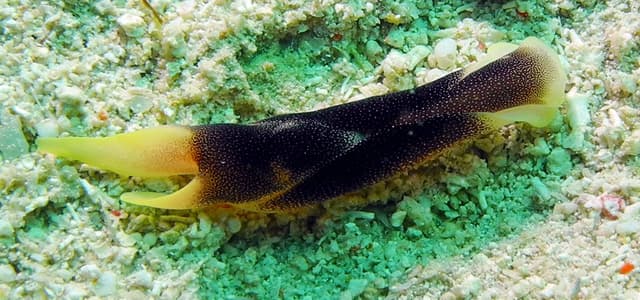
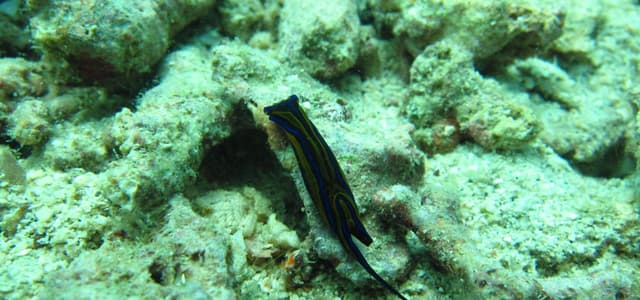
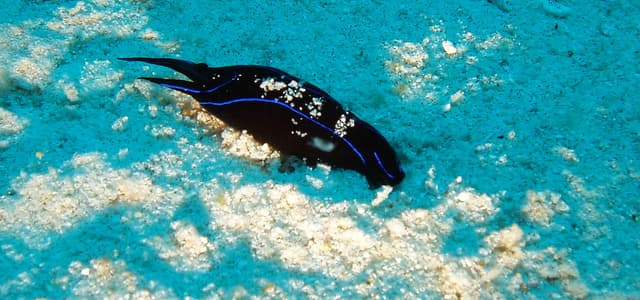
Pilsbury's Headshield Slug
Tubulophilinopsis pilsbryi
Also known as: Batik Tailed Slug, Bubble Snail, Nudibranch, Pilsbury Slug, Tailed Slug, 'Nudibranch' (but they are not)
- Batik Tailed Slug
- Bubble Snail
- Nudibranch
- Pilsbury Slug
- Tailed Slug
- 'Nudibranch' (but they are not)
Overview
Found singly, pairs, or in groups, amongst rubble, sand, and in seagrass beds, of coral and rocky reefs.
Cephalaspidea or Head Shield Snails are of the Opisthobranchia group, some of which still have a shell. The head shield from which this group attain their name, is a broadened part of the head, used to dig into the sand and protect the snail.
All opisthobranchs are hermaphrodites.
These beautiful slugs are usually brilliantly coloured as a deterrent against opportunistic predators. Some sea slugs secrete acid from stinging cells in their tentacles while others secrete acid from cells in their mantle.
They are slow moving, can swim or be propelled along either by muscular contraction or by millions of tiny hairs on the bottom of a fleshy 'foot', they have a voracious appetite and feed with a rasp like tongue.
They lay their eggs in a ribbon effect on the sand, in different colours depending on species.
Their main predator are other Sea slugs.
How to identify
- Pattern
- black lines
- Behaviour
- burrowingloose groupspairssolitary
Tap any trait to see other fish that share it.
Habitat & where to find it
- Range · Indo-West Pacific
- Country only · 3
Found singly, pairs, or in groups, amongst rubble, sand, and in seagrass beds, of coral and rocky reefs.
Adult photos 3
Discussion
No comments yet. Seen one, or got a question about it? Start the discussion.
Deep dive
Taxonomy
- kingdomAnimalia
- phylumMollusca
- classGastropoda
- orderCephalaspidea
- familyAglajidae
- genusTubulophilinopsis
- speciesTubulophilinopsis pilsbryi (Eliot, 1900)
SourcesWoRMSSea Slug Forum
More in the family
Head Shield Slugs (Aglajidae)