Queen Triggerfish
Balistes vetula
Also known as: Caribbean Triggerfish, Old Wife Fish, Queen Trigger, Turbot
- Caribbean Triggerfish
- Old Wife Fish
- Queen Trigger
- Turbot
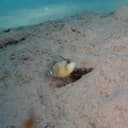
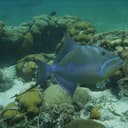
Showing details for the adult stage. Switch stages to see how it differs.
Overview
The queen triggerfish is one of the larger and most colourful triggerfishes of the tropical Atlantic, a powerful-jawed reef fish known for the electric blue rays around its mouth and for flipping sea urchins over to attack them from underneath.
It lives singly or in schools over coral reefs and rocky bottoms, and now and then over sand and seagrass. It usually stays above 30m, although it has been found as deep as 275m. In the west it ranges from Massachusetts to Brazil and is commonest around Florida, the Bahamas and the Caribbean, which is where divers are most likely to meet it. In the east it occurs from the Azores to southern Angola.
Appearance
It often reaches 45cm, and females tend to be larger than males. The body is steel grey to olive green, with orange below the mouth and around the pectoral fin. Electric blue rays surround the mouth, dark blue lines radiate from the eyes, and a blue line finishes the tail. Those colours separate it easily from the grey and ocean triggerfish, large relatives that share parts of its range. Juveniles look much the same but duller, and any fish can adjust its colour a little to match its surroundings or when stressed.
Behaviour
Usually shy, it tends to swim away from divers, though a curious one may circle them. Like other triggerfishes it has a dorsal spine that locks upright, and it uses this to wedge itself into a crevice when resting or escaping a predator.
Feeding
Sea urchins, crabs and chitons are the main prey, with shrimps, snails, bivalves, small fish and brittle stars taken now and then. Tough prey is bitten over and over with sharp incisors to crack it or free it from the reef, and may be spat out and taken again to reposition it or discard hard parts. Quick prey is simply sucked in. All this turning of rocks and stirring of sand draws smaller fish in to pick up the scraps.
Life cycle
Breeding goes on all year, often at a particular spawning ground that the fish migrate to. A shallow pit is dug in the sand with the fin and the eggs are laid inside, then fiercely guarded by the parents. The larvae that hatch are often carried off by currents.
Males mature at about 2.7 years and females at about 4. How long the fish live is still argued over: estimates run from 7 years in an early study to 14 in a later one and as much as 40 from radiocarbon analysis.
Dangers
Eggs change its temperament completely. A fish guarding a nest turns aggressive and territorial, and a harassed parent can give a diver a nasty bite. The flesh may also carry ciguatoxin.
Threats
Larger reef fish such as jacks, groupers and sharks are its main predators, and it carries many parasites, including copepods, isopods, leeches, tapeworms, flukes and nematodes. Populations in United States waters and the Caribbean are broadly healthy, but those off Brazil and in the Gulf of Guinea have fallen by more than 90% since the 1980s through overfishing.
Relationship with people
For many Latin American communities around the Caribbean this is a staple food fish, usually taken by hook and line or in fish traps, and it also comes up on commercial longlines by accident. Puerto Rico and the US Virgin Islands protect its breeding grounds as no-take zones.
The second half of its scientific name, Balistes vetula, means old woman, which matches the Spanish name vieja used in Cuba. An old explanation for the English name old wife fish points to the look of its mouth from the front and the soft murmur it makes when first caught.
Its colours also earn it a place in aquariums, though it is too big and territorial for most home tanks.
Notes & fun facts
- DID YOU KNOWLarger females are thought to be able to release eggs more than 80 times a year, and most breeding happens around the full moon.
- DID YOU KNOWA membrane below the pectoral fins can be used to make a noise that warns other animals away from the eggs.
- DID YOU KNOWThe name Balistes comes from an Italian term for crossbow fish, after the way the second dorsal spine locks the first in place.
- DID YOU KNOWLifespan estimates vary widely, from 7 years in an early study to as much as 40 years in a more recent analysis.
How to identify
- Pattern
- stripes
Tap any trait to see other fish that share it.
Diver’s cheat sheet
- 1BehaviourKeep well clear of a fish guarding eggs, as it becomes very aggressive and can bite divers.
Habitat & where to find it
Where the adult stage lives, and where its photos were taken.
- Range · Atlantic Ocean
- Exact location · 1
- Country only · 4
Found singly or in schools, over coral and rocky reefs, and now and then over sand and seagrass, usually above 30m.
Adult photos 5
Discussion
No comments yet. Seen one, or got a question about it? Start the discussion.
Deep dive
Taxonomy
- kingdomAnimalia
- phylumChordata
- classTeleostei
- orderTetraodontiformes
- familyBalistidae
- genusBalistes
- speciesBalistes vetula Linnaeus, 1758
Morphology
AdultOval and flattened from side to side, with small eyes set high on the head. The small mouth has very powerful jaws and sharp incisors. The first dorsal fin is triangular and its spines wedge the fish into crevices when resting or escaping predators. The second dorsal and anal fins are long and triangular, and the tail is crescent-shaped. Females tend to be larger than males, and juveniles look almost identical to adults but duller.
More in the family
Triggerfishes (Balistidae)
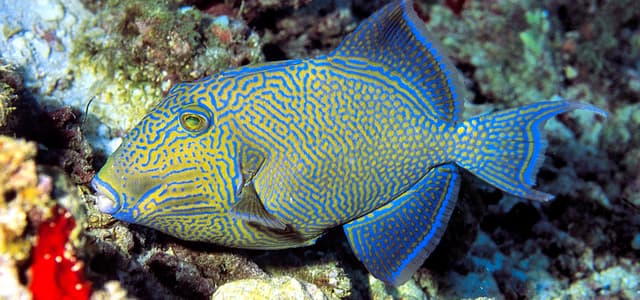
Blue Triggerfish
Pseudobalistes fuscus
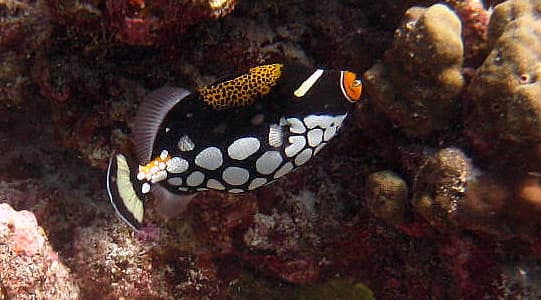
Clown Triggerfish
Balistoides conspicillum
Assasi Triggerfish
Rhinecanthus assasi
2 photos
Black Triggerfish
Melichthys niger
16 photos
Blackpatch Triggerfish
Rhinecanthus verrucosus
6 photos
Blue-lined Triggerfish
Xanthichthys caeruleolineatus
1 photo
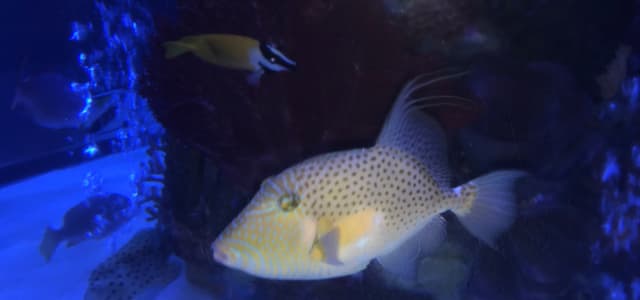
Bluespotted Triggerfish
Balistes punctatus
3 photos
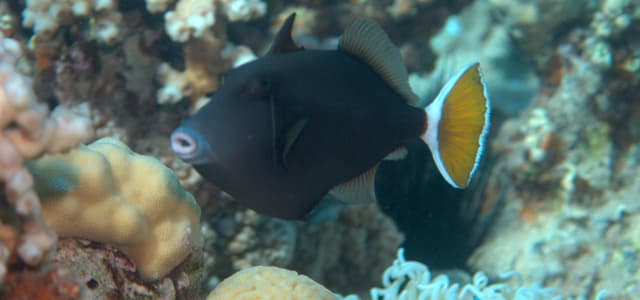
Bluethroat Triggerfish
Sufflamen albicaudatum
3 photos
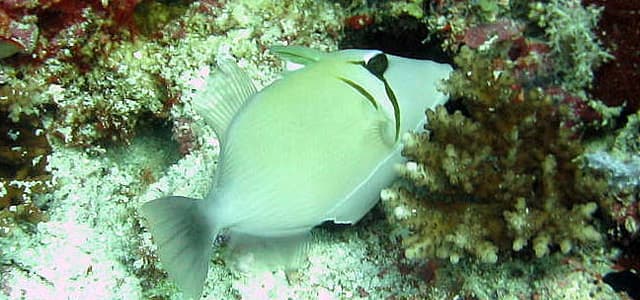
Boomerang Triggerfish
Sufflamen bursa
19 photos
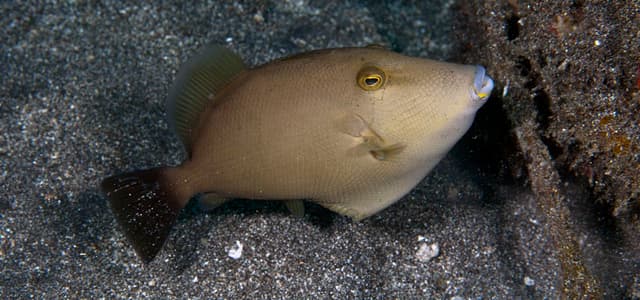
Bridled Triggerfish
Sufflamen fraenatum
3 photos
Crosshatch Triggerfish
Xanthichthys mento
1 photo
Grey Triggerfish
Balistes capriscus